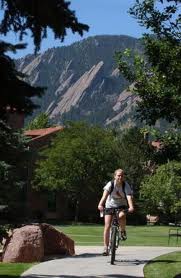
US News and World Report has released their 2013 best law school rankings and our Environmental and Natural Resources Program is ranked at number 17! This publication ranks the best schools in terms of their environmental, energy, sustainable development, and global warming course offerings.
The ranking represents our program’s ongoing efforts to provide relevant, rigorous courses for our students. Part of our positive ranking is due to the variety of opportunities provided to our students to develop their skills and understanding of environmental and natural resources law and policy.
Denver Law offers a variety of opportunities to supplement students' classroom education including the environmental law clinic, environmental law journals, renewable energy, oil and gas, and land use conferences, as well as student organizations. In addition, the externship office directly links students with positions in environmental and natural resources law and policy work. In this manner, our students are able to take all that they have learned from our esteemed faculty and apply their knowledge into work in the field. We feel that this is truly a great asset to our students as it allows them to develop their professional skills inside and outside the classroom.
Associate administrative director Lucy Daberkow commented on this proud accomplishment: "Our program's recognition as a top environmental and natural resources program reinforces our commitment to providing a top-notch education and recruiting some of the best students in the U.S. and abroad."
For more information about our program, visit our website!
Wednesday, March 20, 2013
Friday, March 15, 2013
Environmental Law Clinic Reaches Settlement with Xcel Energy
![]() |
| Mike Harris, Director of the Environmental Law Clinic |
This translates into a tremendous experience for four generations of clinic students. Students assisted in shepherding the case from initial filing through discovery, briefing, oral arguments and trial preparation. The case was settled two weeks away from the trial date.
The settlement will result in benefits for the most impacted communities. Xcel Energy will provide $447,000 to Groundwork Denver, a third-party nonprofit organization which will initiate a sustained improvement of the physical environment through community-based partnerships and action.
Jeremy Nichols, of WildEarth Guardians said, “This is a victory for clean air, for the community, and for Colorado’s clean energy future, as we power past coal, it’s critical that we lay the groundwork for solar and energy efficiency to take root. That’s exactly what this settlement does.”
Angelica Oman
Graduate Program Assistant
Wednesday, March 13, 2013
ENRGP Students Attend Vail Global Energy Forum
![]() |
| Photo Courtesy of Zach Mahone |
Governor Hickenlooper delivered the opening address setting the stage for panelists to discuss energy efficiency and energy innovation. The second day focused entirely on natural gas. Jim Brown, President of the Western Hemisphere at Halliburton, gave an overview of unconventional energy development (hydraulic fracturing). Mark Zoback, a Professor in the Department of Geophysics at the School of Earth Sciences at Stanford University, shared scientific studies linking ground injections to increased seismic activity and the risks of water contamination.
The event was educational and relevant. The students enjoyed their visit to the Rocky Mountains, and the opportunity to hear about energy developments and trends from experts. Attendee Chris Simmons shared, "The Vail Global Energy Forum was an incredible opportunity to bring my personal environmentalism, academic passion, and work experiences into fruition through a two day forum of top-notch academics and industry leading professionals. The forum afforded me an opportunity to network with a wide variety attendees, and to increase my knowledge of global energy concerns and solutions."
Angelica Oman
Graduate Program Assistant
Friday, March 8, 2013
Hydraulic Fracturing and Water Consumption in Texas
Texas is experiencing immense pressure for water resources. The west is in its second year of significant drought. A new study shows that Texas operates one fifth of the world’s operating oil and gas rigs. These developments have led to a serious concern over water uses in hydraulic fracturing.
Water is a crucial component in energy extraction, production and processing. Energy is necessary to transport, treat, heat, cool and recycle water. Energy relies upon water and vis versa, this creates an energy-water nexus.
Last month in Texas, two legislative committees convened hearings regarding hydraulic fracturing and water consumption. The state oil and gas regulator, the Railroad Commission of Texas, and the Texas Water Development Board determined that oil and gas development used more barrels of water (623 million) for fracturing than the barrels of oil it produced (441 million) in 2011.Industry representatives shared methods of reducing water consumption. The most common solution was to substitute brackish water.
Brackish water is expensive and difficult to access in Texas, but may be a powerful tool in other regions. Halliburton, the largest provider of hydraulic fracturing services, recently announced that they had reduced water consumption in the Bakken field by $400,000 per well through recycled water. The immense opportunities to reduce cost and waste associated with energy extraction are apparent.
The nexus between oil and gas production, hydraulic fracturing, energy production, transmission, etc. and water is one that needs to be strengthened. There needs to be continued innovation, careful monitoring and sharing of data. Amelia Nuding a water-energy analyst at Western Resource Advocates recently spoke at the RMLUI’s Annual Land Use conference. She stated that more emphasis should be placed on incorporated the full value of water into the decision-making process.
Water is a crucial component in energy extraction, production and processing. Energy is necessary to transport, treat, heat, cool and recycle water. Energy relies upon water and vis versa, this creates an energy-water nexus.
Last month in Texas, two legislative committees convened hearings regarding hydraulic fracturing and water consumption. The state oil and gas regulator, the Railroad Commission of Texas, and the Texas Water Development Board determined that oil and gas development used more barrels of water (623 million) for fracturing than the barrels of oil it produced (441 million) in 2011.Industry representatives shared methods of reducing water consumption. The most common solution was to substitute brackish water.
Brackish water is expensive and difficult to access in Texas, but may be a powerful tool in other regions. Halliburton, the largest provider of hydraulic fracturing services, recently announced that they had reduced water consumption in the Bakken field by $400,000 per well through recycled water. The immense opportunities to reduce cost and waste associated with energy extraction are apparent.
The nexus between oil and gas production, hydraulic fracturing, energy production, transmission, etc. and water is one that needs to be strengthened. There needs to be continued innovation, careful monitoring and sharing of data. Amelia Nuding a water-energy analyst at Western Resource Advocates recently spoke at the RMLUI’s Annual Land Use conference. She stated that more emphasis should be placed on incorporated the full value of water into the decision-making process.
Angelica Oman
Graduate Program Assistant
Wednesday, March 6, 2013
2011 MRLS Graduate, Stacy Coyle Accepts Faculty Position at the University of Michigan
![]() |
| Director Don Smith and Stacy Coyle at the 2011 Graduation Ceremony |
"The MRLS degree provided me more than an introduction to the major laws and bodies governing our environment and natural resources—both national and international. It widened my understanding of the often deeply conflicting philosophies, interests and regimes that compete to inform those policies. Those debates are what interest me most, both as a student and a teacher.
I have accepted a position at the University of Michigan as a LEO Lecturer III, a joint appointment to the Department of English and the Program in the Environment (PitE). (I will also provide supervision for the PitE internship program.) PitE, now in its tenth year, defines its “mission to develop environmentally informed citizens and leaders through an undergraduate program that balances rigorous environmental studies in many disciplines, hones practical problem-solving skills, and fosters intellectual risk taking.” (See http://www.lsa.umich.edu/pite for more information.) Courses I will be teaching include Environmental Law and Literature, Environmental Justice, Race and Ethnicity, Poetry and Politics of Water, Ecocriticism, and Women Write the Environment."
Congratulations to Stacy!
We wish her all the best in her next chapter!
Wednesday, February 27, 2013
DU Alumni Hani Yaafouri and Zahi Yaafouri to Open Coffee Shop Near Campus
Hani and Zahi are extremely committed to sustainability practices in all aspects of the business, even purchasing a stainless steel filter for drip coffee developed by a company in Portland, OR. "Most coffee shops use anywhere between 80 to 100 paper filters on a daily basis depending on the size of the operation, but we won't be using any paper filters! We also plan on using eco-friendly paper cups."
The ENRGP Program wishes Hani and Zahi all the best in their new business venture!
Please stop by for a cup of coffee.
Friday, February 22, 2013
Colorado to Receive over $2 million for New Bike Trails
U.S. Interior Secretary Ken Salazar and Transportation Secretary Ray LaHood announced earlier this week that Colorado will receive $2.2 million in federal funds to increase access to Rocky Mountain National Park (RMNP) and Chimney Rock National Monument. Most of that money will pay for a new trail link in the Rocky Mountain Greenway.
The completed network will connect hundreds of trails in the Denver area then connect new routes to RMNP and to three wildlife refuges: Rocky Mountain Arsenal, Rocky Flats and Two Ponds. Salazar said the project is part of an effort to "create one of the greatest urban parkway systems" in the nation.
Estes Park is involved with the process and will receive a $337,000 grant for an extension of the Fall River Multi-Use Trail System. Cycling in Estes is currently allowed only on roads, however, park planners are performing an environmental assessment to analyze the possible impacts of bicycling within the RMNP near Grand Lake. A 15.5 mile multi-use (non-motorized) trail from Estes Park's Fall River entrance to Sprague Lake is also being considered.
Bicyclists are making serious headway in their efforts to increase the recreational use of bikes in national parks and establishing rights to access. In July, the NPS allowed greater discretion to park superintendents regarding bicycle use within park boundaries. Many bicycling advocate groups expressed excitement at President Obama's appointment of REI CEO Sally Jewel to replace Salazar. Mark Eller of International Mountain Bicycling Association said, " Our philosophy is to go slow and work with parks that really want to expand their bike options. Any attempts by the NPS to get more familiar with and enthused about multi-use trails is great to see."
The completed network will connect hundreds of trails in the Denver area then connect new routes to RMNP and to three wildlife refuges: Rocky Mountain Arsenal, Rocky Flats and Two Ponds. Salazar said the project is part of an effort to "create one of the greatest urban parkway systems" in the nation.
Estes Park is involved with the process and will receive a $337,000 grant for an extension of the Fall River Multi-Use Trail System. Cycling in Estes is currently allowed only on roads, however, park planners are performing an environmental assessment to analyze the possible impacts of bicycling within the RMNP near Grand Lake. A 15.5 mile multi-use (non-motorized) trail from Estes Park's Fall River entrance to Sprague Lake is also being considered.
Bicyclists are making serious headway in their efforts to increase the recreational use of bikes in national parks and establishing rights to access. In July, the NPS allowed greater discretion to park superintendents regarding bicycle use within park boundaries. Many bicycling advocate groups expressed excitement at President Obama's appointment of REI CEO Sally Jewel to replace Salazar. Mark Eller of International Mountain Bicycling Association said, " Our philosophy is to go slow and work with parks that really want to expand their bike options. Any attempts by the NPS to get more familiar with and enthused about multi-use trails is great to see."
Angelica Oman
Graduate Program Assistant
Subscribe to:
Posts (Atom)


.jpg)