Friday, March 8, 2013

Hydraulic Fracturing and Water Consumption in Texas

Texas is experiencing immense pressure for water resources. The west is in its second year of significant drought. A new study shows that Texas operates one fifth of the world’s operating oil and gas rigs. These developments have led to a serious concern over water uses in hydraulic fracturing.

Water is a crucial component in energy extraction, production and processing. Energy is necessary to transport, treat, heat, cool and recycle water. Energy relies upon water and vis versa, this creates an energy-water nexus.

Last month in Texas, two legislative committees convened hearings regarding hydraulic fracturing and water consumption. The state oil and gas regulator, the Railroad Commission of Texas, and the Texas Water Development Board determined that oil and gas development used more barrels of water (623 million) for fracturing than the barrels of oil it produced (441 million) in 2011.Industry representatives shared methods of reducing water consumption. The most common solution was to substitute brackish water.

Brackish water is expensive and difficult to access in Texas, but may be a powerful tool in other regions. Halliburton, the largest provider of hydraulic fracturing services, recently announced that they had reduced water consumption in the Bakken field by $400,000 per well through recycled water. The immense opportunities to reduce cost and waste associated with energy extraction are apparent.

The nexus between oil and gas production, hydraulic fracturing, energy production, transmission, etc. and water is one that needs to be strengthened. There needs to be continued innovation, careful monitoring and sharing of data. Amelia Nuding a water-energy analyst at Western Resource Advocates recently spoke at the RMLUI’s Annual Land Use conference. She stated that more emphasis should be placed on incorporated the full value of water into the decision-making process.

Angelica Oman
Graduate Program Assistant

Wednesday, March 6, 2013

2011 MRLS Graduate, Stacy Coyle Accepts Faculty Position at the University of Michigan

Director Don Smith and Stacy Coyle
at the 2011 Graduation Ceremony
Stacy Coyle shared the news with the ENRGP Program and provided the following statement:

"The MRLS degree provided me more than an introduction to the major laws and bodies governing our environment and natural resources—both national and international. It widened my understanding of the often deeply conflicting philosophies, interests and regimes that compete to inform those policies. Those debates are what interest me most, both as a student and a teacher.

I have accepted a position at the University of Michigan as a LEO Lecturer III, a joint appointment to the Department of English and the Program in the Environment (PitE).  (I will also provide supervision for the PitE internship program.)  PitE, now in its tenth year, defines its “mission to develop environmentally informed citizens and leaders through an undergraduate program that balances rigorous environmental studies in many disciplines, hones practical problem-solving skills, and fosters intellectual risk taking.” (See http://www.lsa.umich.edu/pite for more information.) Courses I will be teaching include Environmental Law and Literature, Environmental Justice, Race and Ethnicity, Poetry and Politics of Water, Ecocriticism, and Women Write the Environment."

Congratulations to Stacy!
We wish her all the best in her next chapter!
 

Wednesday, February 27, 2013

DU Alumni Hani Yaafouri and Zahi Yaafouri to Open Coffee Shop Near Campus

Associate Administrative Director Lucy Daberkow recently visited with Hani Yaafouri, a 2010 ENRGP MRLS graduate. Hani and his brother Zahi, MBA '03 and MRECM '01, will be opening a new coffee shop, Steam, Espresso Bar next month. You can find construction pictures and more information about Steam on their Facebook page!
Hani and Zahi had been planning to open a coffee shop for a long time. They waited several years until they found the right location. Hani had the following to say:  "We are excited about the location for many reasons. It's in a gorgeous neighborhood ( Old South Pearl Street), and it's a corner location, which is great for a coffee business. The patio is on the south side of the building ( lots of sunshine) and most importantly, it's within a mile from the University of Denver campus.  We love the fact that we are still close to DU!"

Hani went on to say, "We have done a lot of work to upgrade the building from plumbing to electricity to HVAC (heating, ventilation and air conditioning). Zahi is in charge of all the design work. We are  incorporating sustainability in our design as much as possible. We are using reclaimed wood (maple) in the bar area , shelving and counter tops. This reclaimed wood was originally used as flooring for rail way boxcars (very popular in the early 1930's). The old floor joists of the building were reused when we upgraded the building structure. We are also using some of the old floor joists as foot rests in the bar area."

Hani and Zahi are extremely committed to sustainability practices in all aspects of the business, even purchasing a stainless steel filter for drip coffee developed by a company in Portland, OR. "Most coffee shops use anywhere between 80 to 100 paper filters on a daily basis depending on the size of the operation, but we won't be using any paper filters! We also plan on using eco-friendly paper cups."

The ENRGP Program wishes Hani and Zahi all the best in their new business venture! 
Please stop by for a cup of coffee.

Friday, February 22, 2013

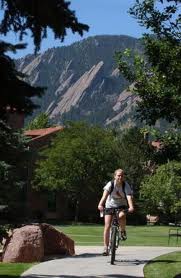
Colorado to Receive over $2 million for New Bike Trails

U.S. Interior Secretary Ken Salazar and Transportation Secretary Ray LaHood announced earlier this week that Colorado will receive $2.2 million in federal funds to increase access to Rocky Mountain National Park (RMNP) and Chimney Rock National Monument. Most of that money will pay for a new trail link in the Rocky Mountain Greenway.

The completed network will connect hundreds of trails in the Denver area then connect new routes to RMNP and to three wildlife refuges: Rocky Mountain Arsenal, Rocky Flats and Two Ponds. Salazar said the project is part of an effort to "create one of the greatest urban parkway systems" in the nation.

Estes Park is involved with the process and will receive a $337,000 grant for an extension of the Fall River Multi-Use Trail System. Cycling in Estes is currently allowed only on roads, however, park planners are performing an environmental assessment to analyze the possible impacts of bicycling within the RMNP near Grand Lake. A 15.5 mile multi-use (non-motorized) trail from Estes Park's Fall River entrance to Sprague Lake is also being considered.

Bicyclists are making serious headway in their efforts to increase the recreational use of bikes in national parks and establishing rights to access. In July, the NPS allowed greater discretion to park superintendents regarding bicycle use within park boundaries. Many bicycling advocate groups expressed excitement at President Obama's appointment of REI CEO Sally Jewel to replace Salazar. Mark Eller of International Mountain Bicycling Association said, " Our philosophy is to go slow and work with parks that really want to expand their bike options. Any attempts by the NPS to get more familiar with and enthused about multi-use trails is great to see."

Angelica Oman
Graduate Program Assistant 

Wednesday, February 20, 2013

Students Sponsored to Attend RMMLF Air Quality Issues Affecting Oil, Gas and Mining Development

The ENRGP Program has selected to sponsor four students' admission to the  Rocky Mountain Mineral Law Foundation's special institute on Air Quality Issues Affecting Oil, Gas and Mining Development next week!

The Air Quality Issues special institute will provide attendees with a thorough understanding of current air quality law, policy, science and public perceptions. These issues will be considered in the specific context of oil, gas and mining. The Rocky Mountain Mineral Law Foundation said, "All attendees will leave this conference with the most current information about air quality and energy and with tips and insights that they can actually use in fulfilling their responsibilities."

The four students selected were: Caleb Harrison, Annie Oman, Darracott Osawe (featured here in our blog) and Ty Nagamatsu. Each of these students demonstrated a keen interest in air quality issues and had a clear vision of the benefits they would receive from the conference.

Caleb Harrison, MRLS '13, commented, "Living in Colorado, it has become obvious that there is a need to develop and maintain healthy and appropriate natural resource policies for local communities, the state, and for the nation. I believe the conference would benefit me; the practical aspects of the conference would complement my academic understanding of the pertinent issues."

Congratulations to the winners!


Friday, February 15, 2013

BLM Resource Advisory Council Meetings Held In Golden, CO

The Resource Advisory Council (RAC) meetings were held this past Wednesday to Friday in Golden, CO. These meetings are open to the public and discuss current issues of the Bureau of Land Management (BLM) in its management of our public lands. The RACs are official federal advisory committees that provide insight and recommendations to the Designated Field Officers. Each RAC is comprised of 15 member, 5 members representing the following areas: commercial interests, environmental groups, and elected officials. This year's meeting included a discussion of healthy landscapes, oil and gas development, the National Landscape Conservation System and other issues.

The first day involved a separate meeting for each of the regional RACs (Northwest, Southwest and Front Range) to meet with the Field Officers. These meetings outline and discuss problems specific to the region. Jim Cagney, Northwest Field Officer commented, "It is nice to get advice from the RAC away from the swirl of emotions." He then went on to discuss contentions raised from various use demands for BLM land. These uses are often in conflict witheach other, such as ATV use and use of the land for shooting.

The second day included panel discussions on various topics relevant to all regions. The first panel discussed Maintaining Healthy Landscapes with speakers from the US Forest Service, the Fish and Wildlife Service and the National Park Service. The next three panels focused on Understanding Oil and Gas Development, Engaging Youth and Veterans in Public Lands and National Landscape Conservation Implementation Strategy. After the panels, the Field Officers and the RAC members broke out into brainstorming groups.

The final day was dedicated to Emilyn Sheffield, Professor of Recreation and Parks Management from California State University, Chico. She highlighted the changing demographics of the United States. She referenced 2010 Census information and Colorado SCORP statistics in her presentation: 55% of Americans are so by choice and 45% of those under the age of five are ethnically diverse. Professor Sheffield encouraged the BLM to change the way in which it interacts with the public and strive to involve a greater variety of stakeholders. She concluded her presentation by saying, "Our current college generation is the best resource of the future. They are an amazing generation and will take us where we've only talked."

It is clear that the BLM faces a variety of issues and decisions regarding demands and uses of its resources. The RAC meetings serve to create new ideas and facilitate a broader understanding of these issues. Other topics of importance were drought management and the implications of dust storms coming into Colorado from Utah. For more information, visit the BLM Resource website.

Angelica Oman
Graduate Program Assistant

Wednesday, February 13, 2013

Diego Parravicini, 2008 LLM Graduate

Diego Parravicini pictured 
during graduation in 2008
Diego Parravicini, 2008 LLM Graduate from the DU College of Law's Environmental and Natural Resources Law and Policy Program and a Senior Attorney [here’s link to his URL] with Estudio Beccar Varela in Buenos Aires, has just published a paper “Sustainability and CSR in Argentina: An Analysis Within Argentine Company Law.”  It can be accessed by clicking here.

Mr. Parravicini, whose paper was published by the prestigious University of Oslo Faculty of Law Legal Studies Research Paper Series, writes, “The beginning of the 1990s in Argentina marked a starting point for a new trend in sustainability, which led to the enactment of stringent environmental regulations and the incorporation of environmental concerns into the National and provincial Constitutions.  However, the scope of this reform concerning sustainability did not extend to Argentine company law.  To date, Argentine company law does not provide for any specific and/or direct requirements in connection with sustainability…The present paper will not only provide an analysis of the barriers identified by such scholars, but also propose ways in which sustainability could be promoted through Argentine company law.”